
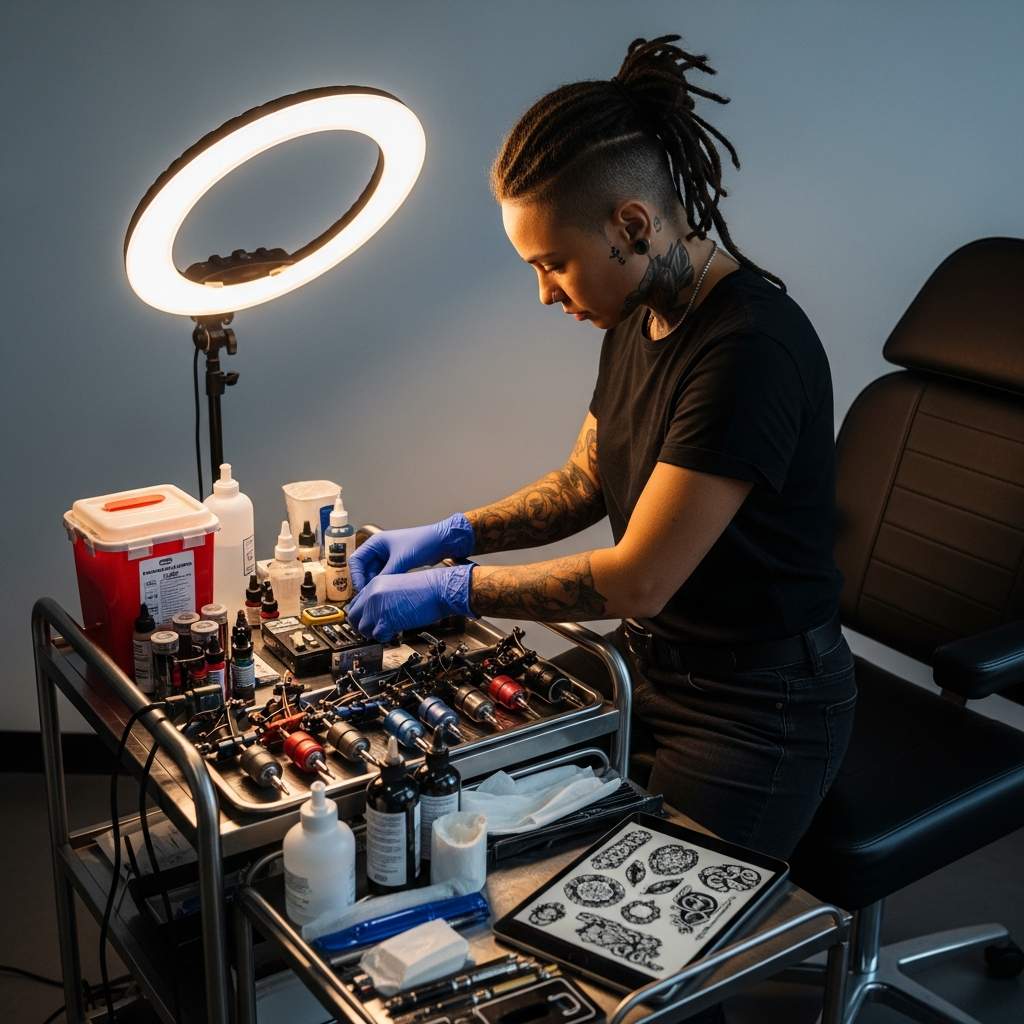

OSHA Bloodborne Pathogens: Body Art Professional
$44.95
The online OSHA compliant Bloodborne Pathogens: Body Art Professional bloodborne pathogen certification for tattoo artists provides you with important information about OSHA’s Bloodborne Pathogens Standard and specific training required by those who work in a body art environment.
Instant access course
- Begin training immediately after checkout
- Instant certificate on completion with QR verification
- 100% acceptance money back guarantee
How Tattoo & Body Art BBP Training Works
Complete tattoo- and body-art-specific bloodborne pathogens training at your own pace, then download a verifiable completion certificate immediately after finishing.
Purchase Securely
Complete checkout using your preferred secure payment method. Course access is issued immediately.
Start Your Training
Learn the foundations of BBP safety alongside tattoo, piercing, PMU, and body-art-specific content.
Learn at Your Pace
Train on desktop, tablet, or mobile. Your progress is saved, so you can pause and return when convenient.
Complete Assessments
Work through four assessments covering exposure control, PPE, sanitation, sharps, and studio safety.
Download Your Certificate
Finish the course and access your digital completion certificate with QR verification straight away.
Nationwide Acceptance
Trusted by Tattoo & Body Art Professionals Nationwide
Our tattoo and body art bloodborne pathogens certificate is accepted across the United States in the vast majority of jurisdictions. The official listings below are selected examples of state and local authority approvals—not a complete list of where the training is accepted.
- City of Philadelphia Public Health Department
- State of Iowa Department of Inspections & Appeals
- Sonoma County, California Environmental Health
- Davis County, Utah Health Department
- Wichita Falls, Texas Public Health District
Check local requirements: some states, counties, and licensing boards set additional or different body-art training requirements. Use the state table below to confirm your local rule. If your relevant authority does not accept this certificate, our money-back acceptance guarantee applies.
Choose With Confidence
What to Look For in Body Art BBP Training
A completion certificate matters, but the training behind it matters too. Before enrolling, make sure a course is relevant to your work, practical to complete, and suitable for your local requirements.
Body-Art-Specific Content
Look for training that addresses tattooing, piercing, PMU, microblading, studio sanitation, and sharps safety—not just general workplace theory.
Meaningful Course Depth
Training should cover exposure controls, PPE, decontamination, waste handling, post-exposure steps, and the practical realities of studio work.
Local Requirement Clarity
State, county, city, and licensing-board requirements can differ. Check the applicable local rule before enrolling.
Verifiable Completion Record
Choose a provider that gives you a durable completion certificate that can be downloaded, reprinted, and independently verified when needed.
Flexible Online Access
Self-paced training with saved progress makes it easier to complete a substantial course around studio appointments and daily work.
A Way to Evaluate It First
A genuine preview lesson lets you assess the teaching style and course experience before committing to a purchase.
Designed for Studio Professionals
More Than a Generic BBP Course
This training is built for artists and studio teams who work with skin-breaking procedures—not simply adapted from a general workplace course.
Body-Art-Specific Training
Learn about tattooing, piercing, PMU, microblading, contamination control, sanitisation, and safe studio practice.
Substantive Course Content
Thirty-five lessons and four assessments cover BBP fundamentals alongside body-art-specific procedures and risks.
Flexible, Self-Paced Access
Start immediately and complete the course around appointments on desktop, tablet, or mobile—with saved progress.
Support Beyond Completion
Access your certificate whenever you need it, use QR verification when requested, and get help if you have a question.
Who This Course Is For
Built for Tattoo & Body Art Professionals
This course is designed for people who perform, assist with, or supervise skin-piercing body-art procedures. It combines bloodborne pathogens training with practical studio safety, sanitation, and exposure-control content.
Check your local rule: state, county, city, and licensing-board requirements can differ. Use the State Requirements tab below to confirm what applies where you work.
-
1
Tattoo Artists
For artists performing tattoo procedures in a studio, salon, convention, or private workspace.
-
2
Body Piercers
For professionals working with needles, jewellery, skin preparation, and sharps disposal.
-
3
Permanent Makeup Artists
For cosmetic tattoo professionals working on brows, lips, eyeliner, scalp micropigmentation, and similar procedures.
-
4
Microblading Artists
For practitioners using manual blades or similar techniques that intentionally break the skin.
-
5
Body Modification Artists
For professionals carrying out other body-art procedures with a foreseeable bloodborne-pathogen exposure risk.
-
6
Studio Owners & Managers
For owners and managers responsible for safe practices, training records, and supporting individual staff training.
Bloodborne Pathogens for Tattoo Artists Course Outline
| Module | Lessons & Course Content |
|---|---|
| Introduction to Bloodborne Pathogens |
Bloodborne Pathogens Introduction: Comprehensive course overview. What are Bloodborne Pathogens?: Types of pathogens commonly encountered in the workplace. Spread and Transmission of BBP: Bodily fluids and primary methods of infection spread. Sharps Injury Statistics*: Analysis of how and why sharps injuries occur. *Additional content not required by OSHA The Bloodborne Pathogens Standard: History, primary goals, and purpose of the OSHA standard. Who is covered by the Bloodborne Pathogens Standard: Identifying personnel and roles under OSHA coverage. |
| Common Bloodborne Pathogens |
Hepatitis B: Transmission, infection risks, symptoms, and vaccination/treatment. Hepatitis C: Transmission, infection risks, symptoms, and treatment options. Comparison Between HBV and HCV: Analysis of risk profiles, prevalence, and treatment differences. HIV: Understanding the virus, transmission methods, and symptoms. |
| Exposure Controls and PPE |
Employer Obligations: Mitigation strategies to control BBP in the workplace. Employers Control Plan: Minimum mandatory requirements for a written Exposure Control Plan (ECP). Bloodborne Pathogens Training: Mandatory OSHA requirements, frequency, and annual retraining rules. Universal Precautions: Definition, importance, and workplace implementation. Work Practice Controls: Behavior-based safety measures and implementation. Engineering Controls: Physical devices and technology used to mitigate risk. Personal Protective Equipment: Selection, standards, use, and employer obligations. Proper Glove Removal: Protocols for correctly donning and doffing nitrile gloves. HBV Immunization: Rights to free vaccination and formal declination protocols. Exposure Incidents and Reporting: Immediate action steps and required post-exposure protocols. Housekeeping: Cleaning, sanitization, and employer maintenance responsibilities. Sharps Injury Logs: Mandated tracking protocols (includes downloadable pro forma log). |
| Body Art Professional Module |
Why do Body Artists need additional BBP training?: Addressing the unique risks of intentional skin-breaking procedures. Anatomy of the skin: Understanding the epidermis and dermis layers as they relate to pigment placement and infection risk. How a tattoo is created: The mechanical process of tattooing and how it facilitates pathogen entry into the body. Tattoo and piercing related medical issues: Common complications, including localized infections and allergic reactions. Other communicable diseases: Risks beyond BBP, such as MRSA, Staph, and other skin infections relevant to studios. Requirements in a Body Art workplace: Facility standards, layout, and ventilation requirements for safe operation. Cleaning, disinfection and sterilization: Differentiating between surface disinfection and the autoclave sterilization of reusable tools. PPE for Body Artists: Specific use of barriers, gloves, and aprons during a procedure to prevent cross-contamination. Preparing to tattoo or pierce: Aseptic station setup, skin preparation, and the use of single-use items. Tattoo and piercing aftercare: Educating the client on wound management to prevent post-procedure infection. Biohazard waste: Proper disposal of sharps and blood-soaked materials in a studio setting. Additional exposure control regulations: Reviewing state-specific and local health department mandates for body art. Post exposure requirements: Specific steps for artists to follow after a needle stick or splash incident in a studio. |
Bloodborne Pathogens Certification for Tattoo Artists: Learning Outcomes
| Competency Area | Learning Objectives: “The Student Will Be Able To…” |
|---|---|
| Phase 1: Regulatory Foundations |
|
| Phase 2: Protective Strategies |
|
| Phase 3: Clinical & Legal Rights |
|
| Phase 5: Body Art Mastery |
|
Our bloodborne pathogens certificate for tattoo artists is full US letter size – which is suitable for framing and display in your tattoo studio, cosmetic tattoo clinic or any other workplace to prove your OSHA certification status.
Tattoo licensing requirements differ from state to state and even by individual county, so it is important to research your local requirements. You can find out everything you need to know in the guide: How to get a tattoo license in the USA (2026 State-by-State Guide).
The OSHA rule is that all INDIVIDUALS must be bloodborne pathogen certified. You can enter anything you want in the name fields at checkout, but this does not make your studio ‘certified’. In some cases studios do want to display a certificate with a studio name in addition to individual artists certificates to make customers feel more comfortable – in this scenario an additional certificate for the studio name can be purchased under a different email and account.
The tattoo certification expires one year after issue. This is a requirement under the OSHA 29 CFR 1910.1030 Bloodborne Pathogens Standard.
Yes. The Body art professional course is suitable for bloodborne pathogens certification for microblading artists and permanent cosmetic artists.
Several other countries follow the OSHA BBP standard for tattooing, for example, New Zealand and South Africa, and in countries that have no specific requirement many artists do still benefit from undergoing the training. Our focus is on providing bloodborne pathogen training for tattoo artists, piercers and microbladers in the United States in line with OSHA standards. If you live outside the US you are welcome to take the course however you should check your local rules and regulations thoroughly beforehand.
Yes, our courses are designed with a ‘mobile first’ approach and work perfectly on any device. We also use file compression and a Content Delivery Network (CDN) to deliver a lighting fast experience on any internet or data connection.
When your bloodborne pathogen certification for tattoo artist is close to expiry, you will automatically receive a discount code to re-certify at a 15% discount.
No, sorry. Our bloodborne pathogen training for tattoo artists is accepted in all other states. Florida has some unique and onerous requirements so you will need to seek training from a local provider.
19 reviews for OSHA Bloodborne Pathogens: Body Art Professional
Only logged in customers who have purchased this product may leave a review.
Fran Sanchez (verified owner) –
its a bit of a yearly chore to it but as tattooists we have to keep current and follow the codes, this site is the best course I have find and makes it almost fun, salute!
Hew Jevicks (verified owner) –
Have to do the cert every year for the last five years ive been an artist, have tried a few courses and this is the best one so far, easy to use, looks modern and could do it on my iPhone, will use again next year thanks
Tabitha Barrett (verified owner) –
Easy course. Everything is explained easily where anyone can understand it. Will recommend to others
Violet Morin (verified owner) –
Lots of Information to learn as a new artist. Easy modules
Marissa Flater (verified owner) –
A quick and affordable class with tons of great information for new artists to learn!
Cecilia Aquino (verified owner) –
easy to understand and packed with important information!
Jared Wallace (verified owner) –
Very straight forward, simple and always useful!
Travis Dodge (verified owner) –
I have used BBC in years past and everything always goes smoothly with quick certificate delivery.
May Wang –
It’s very good, my only complaint is I would like some of the lessons put together into longer form some are a bit short. I have tried quite a lot of training sites for my annual BBP including pro bloodborne and blx and this one is by the far the best way of showing the required content.
Peyton Oller (verified owner) –
Easy to understand and works well on mobile phones! Certified immediately after. Never better!
Lee Stafford (verified owner) –
Not the cheapest but course is very well put together and has a ton more content specific to tattooing than others I have tried. Process was fast from start to finish.
Jenny Taylor (verified owner) –
I’ve taken this course for the past 3 years and it’s great for information and easy to learn. The graphics help a lot for visual learners too. I’ve had an issue after purchasing of the course not populating fo me. I sent an email and got a very quick response with a fix done right away. Very impressed with the speed I was helped.
Rob Oliver (verified owner) –
Great way to get my cert, was done quickly and a nice looking certificate.
Nicole Mendez (verified owner) –
This was a great way to get a verified certification! Easy and efficient!
Steve H (verified owner) –
Everything was covered in detail, easy to use and fast cert, the QR code worked straight away
Brendan Ruiz (verified owner) –
Great course a lot of detail for tattoo artists.
Rachelle Cruz (verified owner) –
3rd year doing it did red cross before this is WAY better and breezy on iphone
Andy Moir (verified owner) –
Nice course covered everything I expected, fast and easy
Greg S (verified owner) –
Decent course and certificate looks nice, had a few issues navigating the training on a tablet though overall it’s good