
How to Get a Tattoo License in the USA (2026 State-by-State Guide)
If you’ve decided to finally take the plunge and become a licensed tattoo artist in 2026, or you are planning to open your own studio it’s time to learn about how to get your tattoo license.
The question probably on your mind is ‘how do I get a tattoo license?’
Nowadays, tattooing has become a multi-million dollar business sector. For artistically inclined individuals, becoming a certified tattoo artist is a fantastic career choice. However, in the United States, tattooing regulations differ depending on your age, education level, certifications, and the state in which you plan to practice. There are several fundamental criteria that can aid you on your way to getting your tattoo license.
Most states in the USA mandate you to obtain a tattoo license before becoming a tattoo artist, while others may require you to maintain a formal business location.
It should be emphasized that there is no federal law that regulates the profession of tattooing, therefore each state, and even individual counties within a state can regulate the industry as they see fit.
This article will take you through everything you need to know to get a tattoo license in any state the USA.
In a hurry? here’s the quick how to guide
Time needed: 30 days
How to get a tattoo license: Quick Guide for all US States
- Check General Requirements (most States)
Government ID proving age over 18, Online application via State or County portal, Bloodborne Pathogen Certificate.
- Research what training and certification your State requires
High school diploma, CPR certificate, First Aid certificate, Bloodborne Pathogen certificate, Tattoo specific training, State tattoo exam, Proof of apprenticeship, Portfolio, Proof of employment in state licensed studio.
- Review State/County requirements and application process
Each state and some counties have their own rules and requirements for tattoo licensing – scroll to end of the main article for a searchable table of state requirements.
- Take any required training courses e.g. BBP / CPR
Take any state mandated training and certifications so you have them ready for when you apply.
- Collate required documents
Gather all your documentation and check it off against the state requirements. Make sure you review ALL your documentation before submitting your application. This may include older documents like high school diplomas.
- Take state tattoo examination if required
If your state or county requires you to take an examination or test before considering your license application then make an appointment to sit it now.
- Pay fee and Submit Application
Fees are usually payable by check or money order but more states now also accept online payments. Submit your application online or mail it in. Your license will likely take two to four weeks to process.
Ready to Earn Your Bloodborne Pathogens Certificate for Tattoo Artists?
100% OSHA 29 CFR 1910.1030 compliant
Accepted Nationwide
Join 4000+ Artists Who Trust Us for Their Annual Licensing

Why do we need a Tattoo License?
Tattoos have become more widely accepted over time. Thus, tattooing, the art of creating permanent ink designs on a person’s skin, has become a profitable business.
While the admiration for body art continues to grow, states have struggled to keep up with ensuring tattoo artists have the minimum knowledge required in subjects such as Bloodborne Pathogens in order to practice safely.
As a result, requirements for obtaining a tattoo certificate were established in most states.
General Requirements to get a Tattoo License in any American state:
CPR Certification (Only required in some states)
Cardiopulmonary resuscitation (CPR) certification is earned by successful completion of a certified first aid course at an accredited hospital, health care facility, or training facility. The course covers both theoretical and practical aspects of CPR.
In taking up CPR classes, you will learn how to do cardiopulmonary resuscitation as well as how to determine when it is necessary to use, it if it is ever required in your tattoo studio.
First Aid Certification (Only required in some states)
Obtaining a first-aid certificate empowers you to assist other individuals and even animals in need during emergencies. While most individuals attend training as part of a job requirement, these abilities are extremely useful in everyday settings, and the course is open to anybody.
First aid training typically addresses a broad range of techniques for assisting someone who has been injured in emergencies like choking, cuts, fractures, and everything in between.
OSHA Bloodborne Pathogens Certification for Tattoo Artists (Required by all states)
This certification is the most important as it is required as part of the federal OSHA 29 CFR 1910.1030 Bloodborne Pathogens Standard. In addition, it is the most pertinent certification to tattoo studios.
Bloodborne pathogens training is required for all tattoo artists, body artists, micro-bladers, permanent cosmetic artists, body modification artists, piercers and others who are exposed to blood and other potentially infectious materials (OPIM) in the course of their daily practice.
The course must meet the minimum requirements of OSHA’s Bloodborne Pathogens Standard, in addition to any extras specified by the state.
Here is an example Bloodborne Pathogens Certificate for tattoo artists from our site:
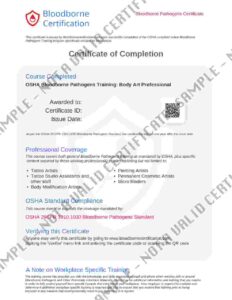
The training will cover subjects such as bloodborne pathogen terminology, modes of transmission, exposure control plans, universal precautions, hepatitis B immunizations, engineering and work practice controls, the anatomy of the skin, infection controls in a body art studio or clinic, and other material crucial to the tattoo artist’s and clients safety.
This course may also include additional subjects on infection control, aseptic procedures, and disease transmission prevention. While the OSHA Bloodborne Pathogens Standard does not mandate these subjects, several states do, and it is strongly recommended to take a tailor made bloodborne pathogens training for tattoo artists course even if they are not required in your state.
If you like, you can take a bloodborne pathogens certification for tattoo artists practice test here before you take a course
Practical or Written Exam (State specific)
The written tattoo artist test will cover required knowledge for professional tattoo artists as well as the laws that regulate their profession.
Candidates who score less than 75% on the laws and regulations section or the professional knowledge questions for tattoo artists must retake the entire written test.
As for the practical exam, on a live model, you will exhibit the abilities you have learned by performing a service linked to your profession. Examiners will assess your competence to complete these activities while keeping a safe and sanitary environment.
Documentation of Apprenticeship
One of the initial stages of getting a tattoo license is to complete an apprenticeship. A formal apprenticeship is like enrolling in a trade school; you do it for the skills and information you will gain, the connections you will establish, the certification you will get, as well as for your professional résumé.
You must seek a skilled tattoo artist who believes you have enough potential to be worth the time and work it will require in training you.
Tattoo Art Portfolio
Tattoo artists, like all other artists, require a portfolio. A tattoo artists portfolio may be a physical portfolio, an online portfolio website or other digital showcase. It should display all the designs, sketches, and examples of your previous tattoo work such that clients may get a sense of your tattoo style.
Most tattoo artists nowadays have a web profile in addition to a printed copy of their portfolio.
Obtain Your Tattoo License Certifications and other Requirements
So now you know what you need and why, the next question you probably have is how the heck do I get all that? Don’t worry – we will now go thru step by step on how to obtain all those requirements.
Step 1: CPR Certification
Currently in 2025, there are 11 states in which you must be certified to perform CPR and first-aid to obtain a tattoo license. Aside from the American Heart Association (AHA), you can also obtain a cardiopulmonary resuscitation (CPR) certification through the American Red Cross. Both of these organizations offer in person training classes only, so you will need to find a class running in your location at a convenient time.
The American Red Cross has something of a monopoly on CPR training despite there being many other much more modern and better designed online CPR courses, we now offer CPR certification as a bundle with the BBP Tattoo certification – certain states do stipulate which provider they will accept so its best to check before taking any course.
We do not recommend the American Red Cross bloodborne pathogen training – it is very outdated, only works on desktop computers and is not tattoo specific – don’t worry though, we’ve got your covered for bloodborne pathogens training.
Step 2: First Aid Online Course
A First Aid Online Course is also required in some states. It must consist of an online element as well as a hands-on session with a certified first-aid instructor.
As with the CPR training, the AHA and Red Cross are safe bets for first aid training, but there are literally thousands of online courses that will also get you a certificate, so do a search online before booking anything.
Step 3: Bloodborne Pathogen Training and Certificate
Here at bloodbornecertification.com, we offer Bloodborne Pathogens certification for tattoo artists that will get you bloodborne pathogens certified online in about 2 hours.
Register for a course and take it either on your laptop, tablet, or phone, you can get an immediate Bloodborne Pathogens Certificate valid for 12 months once you pass.
Step 4: Creating a Tattoo Art Portfolio
After selecting the pieces that you want to exhibit, purchase a portfolio large enough to hold your largest drawings and outputs.
Remember to include a watermark or signature in all of your work and ensure that everything is accounted for.
To create an online tattoo portfolio there are many options – you could host your own site on WordPress or Wix, or simply create a portfolio page on your favorite social media platform.
It is worth considering that whilst a social media presence is pretty much mandatory, creating your own website has many benefits, most importantly, you will own and control your own online space and there are no limits to your creativity when designing it.

Step 5: Get a Tattoo Apprenticeship
The fastest way to find an apprenticeship is to walk into your neighborhood tattoo business and inquire whether they are taking apprentices. It is important to remember to bring your portfolio together with your Bloodborne Pathogens certificate, and your CPR and first-aid certifications if they are required in your state.
Step 6: State Tattoo License Examination
The final step in earning your tattoo license is through undertaking a written exam, which is normally intended to fulfill the state health department’s standards. The cost of obtaining the required license and the exam varies by state.
What Do I Need To Get a Tattoo License In My State?
This is one of the things that gets people very confused because many states and even individual counties in the USA have specific criteria that you need to meet to get a tattoo license.
To make things simple for you we are compiling a dedicated step by step guide for every state. Just click on the STATE LICENSING GUIDE link for your state.
We add more states regularly and plan to have all 50 covered by 2027.
How to get a tattoo license – state specific guides
| State Licensing Guide | BBP Requirement | Training Status |
|---|---|---|
| Virginia | Required | Guide Live |
| Ohio | Required | Guide Live |
| Connecticut | Required | Guide Live |
| Washington | Required | Guide Live |
| Illinois | Recommended | Guide Live |
| Texas | Required | Guide Live |
| Nevada (SNHD) | Required | Guide Live |
| Hawaii | Required | Guide Live |
| Oregon | Required | Guide Live |
| Alabama Coming Soon | Required | Researching |
| Florida Coming Soon | State Approved | In Progress |
| New York Coming Soon | Required | In Progress |
| California Coming Soon | LEA Approved | Researching |
The “Tattoo License Reciprocity” 2026 Guide
If you already have a tattoo license and are moving to another state, your license will not automatically transfer.
- For most states that require OSHA bloodborne pathogens certification and a photo ID, you will need to apply for a new license in that state.
- If you already have a license and are moving to another state that mandates training hours, then you can provide proof of your training hours in a tattoo apprenticeship or the equivalent and attempt to get your hours transferred.
- If your previous state did not require training hours for licensing, and you have been working as a licensed tattoo artist, you may be able to waive the training hours requirement.
Regardless of the circumstances, you must contact the department of health in your new state or county for guidance.
What if I am traveling to another State as a guest Tattoo Artist?
For tattoo artists who will be traveling to a different state temporarily, for example as a guest artist or limited time resident, you may need to apply for a temporary license.
As above, it is crucial to call each state’s department of health before you travel if you plan to practice tattooing or body art.
| Region / Type | Reciprocity Status | Strategy for Artists |
| The “Standard” States | High | States like Texas, Colorado, and Georgia generally accept any OSHA-compliant BBP certificate (like yours) from a reputable provider. |
| The “Strict” Hubs | Low | California (requires LEA approval), Florida (requires FL-specific BBP course), and New York (City vs State vary) often require you to take a new test or specific course even if you are licensed elsewhere. |
| The “Guest Spot” Permits | Medium | Many states (like Oregon or Virginia) offer a “Temporary” or “Guest Artist” permit. These are usually valid for 14–30 days if you can prove you hold an active license in another state. |
The “Guest Artist” 2026 Compliance Checklist
How to get a Tattoo License: Summary
Tattoo artists, or in some cases the tattoo business itself, are now required to get a tattoo license.
In America, most states need you to go through some sort of process to get a tattoo license.
States usually require tattoo artists to be certified in bloodborne pathogens as part of obtaining a license.
Although all states do not mandate licensure or qualifications, it’s a good idea idea to look into them. With a tattoo license comes a certain measure of trustworthiness. This could show a potential employer or client that you have mastered the art of tattooing, and that you take safety seriously.