

HIPAA and Bloodborne Pathogens Certification Bundle (Save $15)
$44.95
The HIPAA and Bloodborne Pathogens certification online course bundle provides you with certifications for both courses.
- OSHA compliant Bloodborne Pathogens: Healthcare Worker
- HIPAA Privacy Certification
Instant access course
- Begin training immediately after checkout
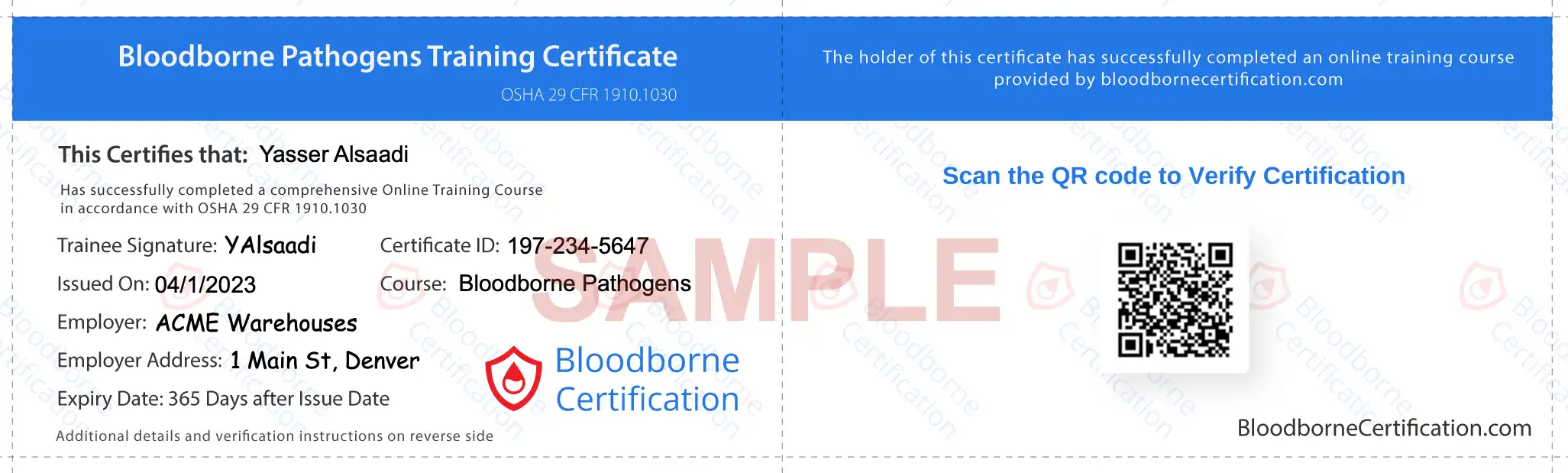
- Instant certificate on completion with QR verification
- 100% acceptance money back guarantee
HIPAA stands for “Health Insurance Portability and Accountability Act” (HIPAA). US President Bill Clinton signed the bill into law on August 21, 1996. The law officially became effective on July 1, 1997.
HIPAA required the Secretary of the U.S. Department of Health and Human Services (HHS) to develop regulations to protect the privacy and security of applicable health information.
Annual Bloodborne Pathogens training is mandated by OSHA.
If you work, or are planning to work, in a healthcare facility that deals with any kind of patient data, and deems employees at risk of exposure to Bloodborne Pathogens, then you will likely need to take both BBP and HIPAA certification courses.
This course bundle gives you both HIPAA and Bloodborne Pathogens certification at a great discount.
The BBP course is tailored specifically to healthcare workers and has some additional modules above and beyond the standard BBP training.
Each course is self-contained and has its own assessments.
For the full detailed individual course coverage please see the BBP Healthcare and HIPAA courses links in the top menu.
Course curricula are updated for 2026 to include the latest HHS Office for Civil Rights (OCR) guidance on patient privacy and digital data security.
HIPAA and Bloodborne Pathogen Certification Training Outline
Course Outline
Module
Lessons & Course Content
Course 1: HIPAA — Privacy & PHI
HIPAA Foundations: The purpose of HIPAA, the Privacy Rule, and the role of healthcare providers and health plans.
Protected Health Information: The 18 identifiers that require protection and practical privacy expectations.
Patient Rights: Access to records, amendments, disclosures, and how to file a complaint.
Course 1: HIPAA — Privacy in Practice
Workplace Boundaries: Distinguishing HIPAA-covered information from standard employment and HR records.
Permitted Disclosures: Sharing information with family, third parties, and law enforcement when permitted.
Emergency Decisions: Applying privacy requirements when a patient is incapacitated or unavailable.
Course 1: HIPAA — Security & Compliance
ePHI Security: Administrative, physical, and technical safeguards for electronic health information.
Risk Management: Assessing privacy risks while balancing data integrity, availability, and clinical access.
Policies & Documentation: Required procedures, training records, and internal compliance responsibilities.
Course 2: Bloodborne Pathogens — Foundations
Bloodborne Pathogens Overview: Common workplace pathogens, transmission routes, and the OSHA Bloodborne Pathogens Standard.
Covered Employees: Identifying workers and job duties with occupational exposure risk.
Key Pathogens: Hepatitis B, Hepatitis C, HIV, transmission risks, symptoms, and available treatment or prevention options.
Course 2: Bloodborne Pathogens — Exposure Controls
Employer Requirements: Exposure Control Plans, required training, and annual retraining responsibilities.
Control Measures: Universal precautions, engineering controls, and work-practice controls that reduce exposure.
PPE & Housekeeping: Selecting and using protective equipment, safe glove removal, cleaning, and sanitation.
Course 2: Bloodborne Pathogens — Worker Rights & Response
Hepatitis B Vaccination: Employee rights to free vaccination and formal declination procedures.
Exposure Incidents: Immediate reporting, post-exposure actions, and follow-up procedures.
Sharps Safety: Sharps injury prevention and required injury-log documentation.
Course 2: Bloodborne Pathogens — Healthcare Settings
Clinical Risk Assessment: High-risk procedures and patient-facing environments where transmission is more likely.
Point-of-Care Testing: Safe blood glucose monitoring and cross-contamination prevention.
Injection Safety: Safe handling of needles, syringes, and injectable medications in line with CDC and OSHA guidance.
Learning Outcomes
Competency Area
Learning Objectives: “The Student Will Be Able To…”
Privacy & Health Information
- Identify PHI: Recognize protected health information and the 18 identifiers covered by HIPAA.
- Apply Patient Rights: Explain patient access, amendment, disclosure, and complaint rights.
- Manage Disclosures: Distinguish appropriate healthcare disclosures from ordinary workplace or HR information sharing.
Security & Risk Management
- Protect ePHI: Apply administrative, physical, and technical safeguards to electronic health information.
- Assess Risk: Identify privacy and security vulnerabilities while maintaining appropriate clinical access.
- Maintain Compliance: Support policy, documentation, training, and reporting requirements.
Bloodborne Pathogen Prevention
- Recognize Exposure Risks: Identify bloodborne pathogens, transmissible fluids, and common routes of exposure.
- Use Protective Controls: Apply universal precautions, engineering controls, work-practice controls, and appropriate PPE.
- Maintain a Safe Workplace: Follow housekeeping, sanitation, sharps-safety, and exposure-control procedures.
Incident Response & Healthcare Practice
- Respond to Exposure: Follow the required reporting and post-exposure steps after a potential bloodborne pathogen incident.
- Understand Worker Rights: Explain hepatitis B vaccination rights and relevant employer responsibilities.
- Apply Clinical Safety: Use safer practices for blood glucose monitoring, injections, needles, syringes, and patient-facing care.
Who needs both BBP and HIPAA certification?
Nurses, Dental Assistants, Medical Receptionists, Medical Couriers
Is this HIPAA training valid for the 2026 tax year/compliance cycle? Both courses are fully updated for 2026 compliance needs.
Does this cover the OSHA 29 CFR 1910.1030 standard AND HIPAA Privacy Rule? Each of these standards is covered in a discrete course ensuring fully audit transparency.
Does a Dental Assistant or Medical Receptionist really need both?
Yes. Under OSHA 1910.1030, any employee with “reasonable anticipation” of contact with blood needs BBP training. Simultaneously, anyone handling patient records (PHI) must be HIPAA certified. Our bundle covers both bases in one 4-hour session.
How do I verify my staff’s certificates during a snap audit?
Every certificate issued comes with a unique Secure QR Code. An inspector can scan it with any smartphone to see live verification on our servers—no phone calls or paperwork required.
| Module | Lessons & Course Content |
|---|---|
| Course 1: HIPAA — Privacy & PHI |
HIPAA Foundations: The purpose of HIPAA, the Privacy Rule, and the role of healthcare providers and health plans. Protected Health Information: The 18 identifiers that require protection and practical privacy expectations. Patient Rights: Access to records, amendments, disclosures, and how to file a complaint. |
| Course 1: HIPAA — Privacy in Practice |
Workplace Boundaries: Distinguishing HIPAA-covered information from standard employment and HR records. Permitted Disclosures: Sharing information with family, third parties, and law enforcement when permitted. Emergency Decisions: Applying privacy requirements when a patient is incapacitated or unavailable. |
| Course 1: HIPAA — Security & Compliance |
ePHI Security: Administrative, physical, and technical safeguards for electronic health information. Risk Management: Assessing privacy risks while balancing data integrity, availability, and clinical access. Policies & Documentation: Required procedures, training records, and internal compliance responsibilities. |
| Course 2: Bloodborne Pathogens — Foundations |
Bloodborne Pathogens Overview: Common workplace pathogens, transmission routes, and the OSHA Bloodborne Pathogens Standard. Covered Employees: Identifying workers and job duties with occupational exposure risk. Key Pathogens: Hepatitis B, Hepatitis C, HIV, transmission risks, symptoms, and available treatment or prevention options. |
| Course 2: Bloodborne Pathogens — Exposure Controls |
Employer Requirements: Exposure Control Plans, required training, and annual retraining responsibilities. Control Measures: Universal precautions, engineering controls, and work-practice controls that reduce exposure. PPE & Housekeeping: Selecting and using protective equipment, safe glove removal, cleaning, and sanitation. |
| Course 2: Bloodborne Pathogens — Worker Rights & Response |
Hepatitis B Vaccination: Employee rights to free vaccination and formal declination procedures. Exposure Incidents: Immediate reporting, post-exposure actions, and follow-up procedures. Sharps Safety: Sharps injury prevention and required injury-log documentation. |
| Course 2: Bloodborne Pathogens — Healthcare Settings |
Clinical Risk Assessment: High-risk procedures and patient-facing environments where transmission is more likely. Point-of-Care Testing: Safe blood glucose monitoring and cross-contamination prevention. Injection Safety: Safe handling of needles, syringes, and injectable medications in line with CDC and OSHA guidance. |
| Competency Area | Learning Objectives: “The Student Will Be Able To…” |
|---|---|
| Privacy & Health Information |
|
| Security & Risk Management |
|
| Bloodborne Pathogen Prevention |
|
| Incident Response & Healthcare Practice |
|
Nurses, Dental Assistants, Medical Receptionists, Medical Couriers
Is this HIPAA training valid for the 2026 tax year/compliance cycle?
Both courses are fully updated for 2026 compliance needs.
Does this cover the OSHA 29 CFR 1910.1030 standard AND HIPAA Privacy Rule?
Each of these standards is covered in a discrete course ensuring fully audit transparency.
Does a Dental Assistant or Medical Receptionist really need both?
Yes. Under OSHA 1910.1030, any employee with “reasonable anticipation” of contact with blood needs BBP training. Simultaneously, anyone handling patient records (PHI) must be HIPAA certified. Our bundle covers both bases in one 4-hour session.
How do I verify my staff’s certificates during a snap audit?
Every certificate issued comes with a unique Secure QR Code. An inspector can scan it with any smartphone to see live verification on our servers—no phone calls or paperwork required.
12 reviews for HIPAA and Bloodborne Pathogens Certification Bundle (Save $15)
Only logged in customers who have purchased this product may leave a review.

Barry Christenson (verified owner) –
Good HIPPA portion, however I did not have time to access to the Bloodborne portion yet. We will see if that is also as good.
Crystal Chang (verified owner) –
Perfect find for me I needed the 2 certs, both courses are very nice I got them done quickly and got my certifications as expected!
Sara Marsh (verified owner) –
The trainings were good on both subjects
Tiffany Holland (verified owner) –
Great Hippa and Bloodborne portion, plan to do more certs
John Sanchez (verified owner) –
Bloodborne Certification is the way to go if you are looking to get certified !!
Frederick Wolters (verified owner) –
Both subjects were nicely presented overall the site is fast and easy to use, thanks
Vikanth Prasat (verified owner) –
the presentations were interesting and fair to complete quiz, i got my certifications thank you
Leslie Sumray (verified owner) –
Both subjects were very good
Olivia Jones (verified owner) –
enjoyed both courses and they are well produced
Arnan P (verified owner) –
as expected and itis fast thanks
Jacorey Laws (verified owner) –
Good program with fast certification
Aurora Roses (verified owner) –
Loved how the course was set up and finished at whichever pace I wanted to complete it at. Easy to pick back up. Only complaint is that there are some abbreviated spelling errors.