
So, it’s 2026, another new year, that came around fast! Now you’ve decided to finally take the plunge and become a licensed tattoo artist, or maybe you are planning to open your own studio.
Congratulations! The question probably on your mind is ‘how do I get a tattoo license?’
Nowadays, tattooing has become a multi-million dollar business sector. For artistically inclined individuals, becoming a certified tattoo artist is a fantastic career choice. However, in the United States, tattooing regulations differ depending on your age, education level, certifications, and the state in which you plan to practice. There are several fundamental criteria that can aid you on your way to getting your tattoo license.
Most states in the USA mandate you to obtain a tattoo license before becoming a tattoo artist, while others may require you to maintain a formal business location.
It should be emphasized that there is no federal law that regulates the profession of tattooing, therefore each state, and even individual counties within a state can regulate the industry as they see fit.
This article will take you through everything you need to know to get a tattoo license in any state the USA.
Why do we need a Tattoo License?
Tattoos have become more widely accepted over time. Thus, tattooing, the art of creating permanent ink designs on a person’s skin, has become a profitable business.
While the admiration for body art continues to grow, states have struggled to keep up with ensuring tattoo artists have the minimum knowledge required in subjects such as Bloodborne Pathogens in order to practice safely.
As a result, requirements for obtaining a tattoo certificate were established in most states.
General Requirements to get a Tattoo License in any American state:
CPR Certification (Only required in some states)
Cardiopulmonary resuscitation (CPR) certification is earned by successful completion of a certified first aid course at an accredited hospital, health care facility, or training facility. The course covers both theoretical and practical aspects of CPR.
In taking up CPR classes, you will learn how to do cardiopulmonary resuscitation as well as how to determine when it is necessary to use, it if it is ever required in your tattoo studio.
First Aid Certification (Only required in some states)
Obtaining a first-aid certificate empowers you to assist other individuals and even animals in need during emergencies. While most individuals attend training as part of a job requirement, these abilities are extremely useful in everyday settings, and the course is open to anybody.
First aid training typically addresses a broad range of techniques for assisting someone who has been injured in emergencies like choking, cuts, fractures, and everything in between.
OSHA Bloodborne Pathogens Certification for Tattoo Artists (Required by all states)
This certification is the most important as it is required as part of the federal OSHA 29 CFR 1910.1030 Bloodborne Pathogens Standard. In addition, it is the most pertinent certification to tattoo studios.
Bloodborne pathogens training is required for all tattoo artists, body artists, micro-bladers, permanent cosmetic artists, body modification artists, piercers and others who are exposed to blood and other potentially infectious materials (OPIM) in the course of their daily practice.
The course must meet the minimum requirements of OSHA’s Bloodborne Pathogens Standard, in addition to any extras specified by the state.
Here is an example Bloodborne Pathogens Certificate for tattoo artists from our site:
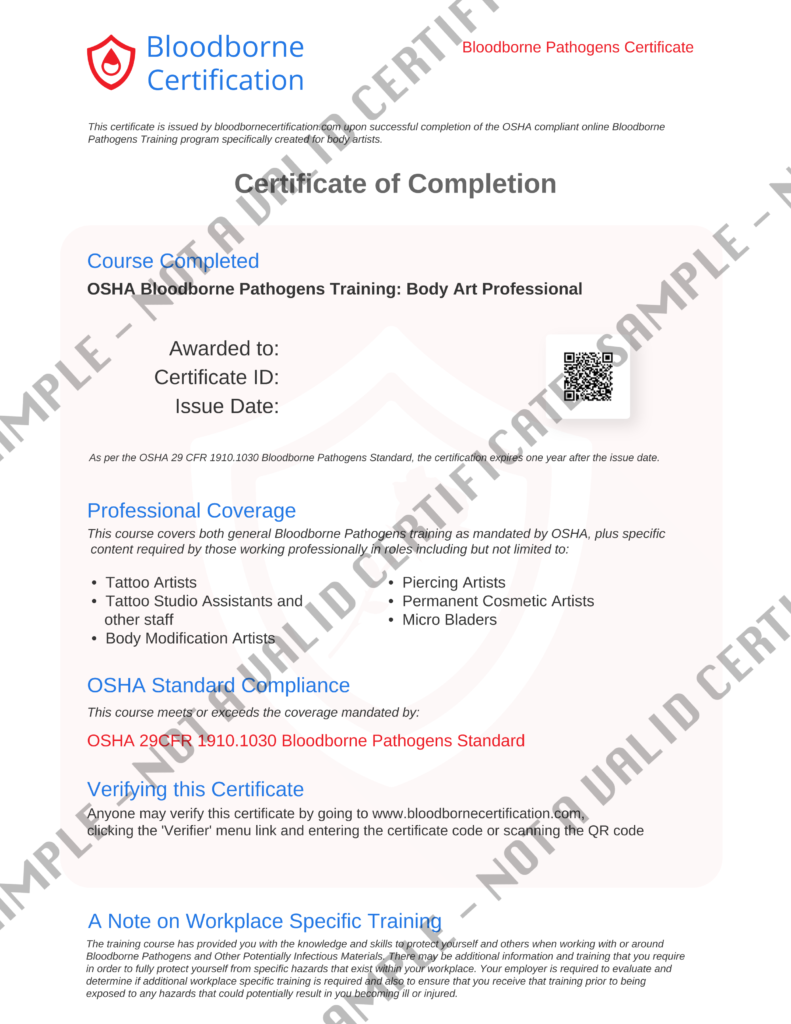
The training will cover subjects such as bloodborne pathogen terminology, modes of transmission, exposure control plans, universal precautions, hepatitis B immunizations, engineering and work practice controls, the anatomy of the skin, infection controls in a body art studio or clinic, and other material crucial to the tattoo artist’s and clients safety.
This course may also include additional subjects on infection control, aseptic procedures, and disease transmission prevention. While the OSHA Bloodborne Pathogens Standard does not mandate these subjects, several states do, and it is strongly recommended to take a tailor made bloodborne pathogens training for tattoo artists course even if they are not required in your state.
If you like, you can take a bloodborne pathogens certification for tattoo artists practice test here before you take a course
Practical or Written Exam (State specific)
The written tattoo artist test will cover required knowledge for professional tattoo artists as well as the laws that regulate their profession.
Candidates who score less than 75% on the laws and regulations section or the professional knowledge questions for tattoo artists must retake the entire written test.
As for the practical exam, on a live model, you will exhibit the abilities you have learned by performing a service linked to your profession. Examiners will assess your competence to complete these activities while keeping a safe and sanitary environment.
Documentation of Apprenticeship
One of the initial stages of getting a tattoo license is to complete an apprenticeship. A formal apprenticeship is like enrolling in a trade school; you do it for the skills and information you will gain, the connections you will establish, the certification you will get, as well as for your professional résumé.
You must seek a skilled tattoo artist who believes you have enough potential to be worth the time and work it will require in training you.
Tattoo Art Portfolio
Tattoo artists, like all other artists, require a portfolio. A tattoo artists portfolio may be a physical portfolio, an online portfolio website or other digital showcase. It should display all the designs, sketches, and examples of your previous tattoo work such that clients may get a sense of your tattoo style.
Most tattoo artists nowadays have a web profile in addition to a printed copy of their portfolio.
-
BBP: Body Art Professional + CPR/AED (Save $15)
$58.95 Add to cartRated 5.00 out of 5If you are applying for your tattoo license you may need to do CPR certification in addition to Bloodborne Pathogens Certification. This bundle gives you both BBP and CPR certificates after completing the individual courses. Save on the cost of individual certifications.
-
BBP: Body Art Professional – Studio Display Bundle (Save $15)
$49.95 Add to cartRated 4.90 out of 5The online Bloodborne Pathogens: Body Art Professional Studio Display Bundle set of courses provides you with OSHA Bloodborne Pathogens Certification, plus a full size frameable certificate to display in your studio or salon after passing the additional Cleaning & Disinfecting Tattoo Studios & Salons course. Give your customers that extra feeling of comfort by showing your credentials directly in your workspace.

Obtain Your Tattoo License Certifications and other Requirements
So now you know what you need and why, the next question you probably have is how the heck do I get all that? Don’t worry – we will now go thru step by step on how to obtain all those requirements.
Step 1: CPR Certification
Currently in 2025, there are 11 states in which you must be certified to perform CPR and first-aid to obtain a tattoo license. Aside from the American Heart Association (AHA), you can also obtain a cardiopulmonary resuscitation (CPR) certification through the American Red Cross. Both of these organizations offer in person training classes only, so you will need to find a class running in your location at a convenient time.
The American Red Cross has something of a monopoly on CPR training despite there being many other much more modern and better designed online CPR courses, we now offer CPR certification as a bundle with the BBP Tattoo certification – certain states do stipulate which provider they will accept so its best to check before taking any course.
We do not recommend the American Red Cross bloodborne pathogen training – it is very outdated, only works on desktop computers and is not tattoo specific – don’t worry though, we’ve got your covered for bloodborne pathogens training.
Step 2: First Aid Online Course
A First Aid Online Course is also required in some states. It must consist of an online element as well as a hands-on session with a certified first-aid instructor.
As with the CPR training, the AHA and Red Cross are safe bets for first aid training, but there are literally thousands of online courses that will also get you a certificate, so do a search online before booking anything.
Step 3: Bloodborne Pathogen Training and Certificate
Here at bloodbornecertification.com, we offer Bloodborne Pathogens certification for tattoo artists that will get you bloodborne pathogens certified online in about 2 hours.
Register for a course and take it either on your laptop, tablet, or phone, you can get an immediate Bloodborne Pathogens Certificate valid for 12 months once you pass.
Step 4: Creating a Tattoo Art Portfolio
After selecting the pieces that you want to exhibit, purchase a portfolio large enough to hold your largest drawings and outputs.
Remember to include a watermark or signature in all of your work and ensure that everything is accounted for.
To create an online tattoo portfolio there are many options – you could host your own site on WordPress or Wix, or simply create a portfolio page on your favorite social media platform.
It is worth considering that whilst a social media presence is pretty much mandatory, creating your own website has many benefits, most importantly, you will own and control your own online space and there are no limits to your creativity when designing it.

Step 5: Get a Tattoo Apprenticeship
The fastest way to find an apprenticeship is to walk into your neighborhood tattoo business and inquire whether they are taking apprentices. It is important to remember to bring your portfolio together with your Bloodborne Pathogens certificate, and your CPR and first-aid certifications if they are required in your state.
Step 6: State Tattoo License Examination
The final step in earning your tattoo license is through undertaking a written exam, which is normally intended to fulfill the state health department’s standards. The cost of obtaining the required license and the exam varies by state.
What Do I Need To Get a Tattoo License In My State?
This is one of the things that gets people very confused because many states in the USA have specific criteria that you need to meet to get a tattoo license.
To make things super simple for you we have provided a quick overview and links to every state tattoo licensing information in the table below. Just locate your state and make sure you have all the requirements covered before applying for your tattoo license!
Just type your State Name in the search box to find out what you need to get a tattoo license.
How to get a tattoo license - state specific requirements table
| State (A-Z) | CPR Required | First Aid Required | Bloodborne Pathogens Required | High School Diploma Required | State Specific Requirements | Link to .gov state licensing info |
|---|---|---|---|---|---|---|
| Alabama | ✓ | Documentation of attendance at a bloodborne pathogen course or training program offered or approved by the Health Department within the last 36 months before applying for the permit | https://www.alabamapublichealth.gov/foodsafety/body-art.html | |||
| Alaska | ✓ | ✓ | A certified true copy of the current CPR card and blood-borne pathogens card | https://www.commerce.alaska.gov/web/portals/5/pub/bah4464.pdf | ||
| Arizona | No license required | https://www.azleg.gov/legtext/49leg/1r/summary/s.1232heath-ced.doc.htm | ||||
| Arkansas | ✓ | ✓ | N | https://www.healthy.arkansas.gov/programs-services/topics/tattoo-and-body-art | ||
| California | ✓ | LEA-Approved Bloodborne Pathogen Course Completion Certificate | https://www.placer.ca.gov/3294/Tattoos-Body-Art | |||
| Colorado | ✓ | ✓ | ✓ | LEA-Approved Bloodborne Pathogen Course Completion Certificate | Not applicable | |
| Connecticut | ✓ | ✓ | A completed course on disease transmission prevention and blood-borne pathogens that meets the federal Occupational Safety and Health Administration's standards is required. | https://portal.ct.gov/DPH/Practitioner-Licensing--Investigations/Tattoo/Licensing-After-112015 | ||
| Delaware | Shops must be registered, and store owners must have permission from the Delaware Department of Health, however, no individual license is required. | https://firststeps.delaware.gov/body_art/ | ||||
| Florida | ✓ | Proof must be provided | http://www.floridahealth.gov/environmental-health/tattooing/tattoo-artist.html | |||
| Georgia | ✓ | ✓ | ✓ | Evidence of completion of an OSHA-approved Bloodborne Pathogen/Universal Precautions training program and a Red Cross Basic First Aid/CPR certification or equivalent is needed. | https://dph.georgia.gov/environmental-health/body-art | |
| Hawaii | ✓ | Proof of Successful Completion of a Bloodborne Pathogens Course from an Accredited Training Facility is required | https://health.hawaii.gov/san/files/2018/06/instructions-to-obtain-tattoo-artist-license.pdf | |||
| Idaho | Businesses must be registered, and store owners must have permission from the Idaho Department of Health, but still, no individual license is needed. | Not applicable | ||||
| Illinois | ✓ | N | https://dph.illinois.gov/topics-services/environmental-health-protection/body-art-establishments | |||
| Indiana | ✓ | N | https://www.in.gov/health/idepd/healthcare-associated-infections-and-antimicrobial-resistance-epidemiology/sanitary-operations-for-cosmetic-services/tattoo-and-body-piercings/ | |||
| Iowa | ✓ | ✓ | Online diplomas will not be accepted. | Not applicable | ||
| Kansas | ✓ | ✓ | N | https://www.kansas.gov/kboc/BodyArt.htm | ||
| Kentucky | Tattoo artists are not required to obtain licenses in Kentucky, but they must register their operations to be certified and inspected. | https://louisvilleky.gov/government/health-wellness/services/tattoo-and-body-art | ||||
| Louisiana | Tattoo artists in Louisiana are not required to be licensed. It simply requires shop registration and permission from the Louisiana Department of Health and Hospitals for business owners, but no individual license is necessary. | https://ldh.la.gov/index.cfm/page/622 | ||||
| Maine | ✓ | N | https://www.maine.gov/dhhs/mecdc/environmental-health/el/business/business-answers-tattoos.htm | |||
| Maryland | ✓ | Tattoo and body piercing shops are not licensed by the Maryland Department of Health. However, you must adhere to special tattooing standards, which specify that all tattooing must be carried out under State regulations governing skin-penetrating body ornamentation methods. | https://health.maryland.gov/phpa/OEHFP/EH/Pages/Tattooing.aspx | |||
| Massachusetts | ✓ | ✓ | N | https://www.mass.gov/doc/body-art-establishments-model-regulations/download | ||
| Michigan | ✓ | N | https://www.michigan.gov/mdhhs/0,5885,7-339-71551_27716_73975---,00.html | |||
| Minnesota | ✓ | N | https://mn.gov/elicense/a-z/?id=1083-231092#/list/appId//filterType//filterValue//page/1/sort//order/ | |||
| Mississippi | ✓ | N | https://msdh.ms.gov/page/resources/880.pdf | |||
| Missouri | ✓ | ✓ | ✓ | Proof must be provided | https://pr.mo.gov/tattooing.asp | |
| Montana | ✓ | ✓ | N | https://dphhs.mt.gov/publichealth/fcss/bodyart | ||
| Nebraska | ✓ | ✓ | ✓ | For bloodborne pathogen training: | https://rules.nebraska.gov/ | |
| Nevada | ✓ | N | https://dpbh.nv.gov/Reg/Invasive_Body_Decoration_(Tattoo)/Invasive_Body_Decoration/ | |||
| New Hampshire | ✓ | N | https://www.oplc.nh.gov/board-body-art-practitioners | |||
| New Jersey | ✓ | N | https://www.nj.gov/health/ceohs/documents/phss/bodyart.pdf | |||
| New Mexico | ✓ | ✓ | ✓ | N | https://www.rld.nm.gov/boards-and-commissions/individual-boards-and-commissions/body-art-practitioners/ba-licensing-services/apply-for-a-ba-license/ | |
| New York | ✓ | N | https://www1.nyc.gov/assets/doh/downloads/pdf/hany/tattoo-license-app.pdf | |||
| North Carolina | ✓ | ✓ | A tattoo artist must have a certificate of completing a Bloodborne Pathogens course as authorized by the Department, | https://ehs.dph.ncdhhs.gov/faf/pti/docs/GS130A-283.pdf | ||
| North Dakota | ✓ | ✓ | N | https://www.hhs.nd.gov/sites/www/files/documents/DOH%20Legacy/FL/F%26L%20PDF/Tattoo_Regs.pdf | ||
| Ohio | ✓ | ✓ | N | https://clients.ohiosbdc.ohio.gov/DocumentMaster.aspx?doc=2809 | ||
| Oklahoma | ✓ | ✓ | ✓ | N | https://oklahoma.gov/health/services/licensing-inspections/consumer-health-service/body-piercing-and-tattooing.html | |
| Oregon | ✓ | ✓ | ✓ | ✓ | For bloodborne pathogen training | https://www.oregon.gov/oha/PH/HLO/Pages/Board-Body-Art-Practitioners-Tattoo-Artists-License.aspx |
| Pennsylvania | Tattoo artists in Pennsylvania do not need to pass exams or obtain a license to practice. | Not applicable | ||||
| Rhode Island | ✓ | N | https://health.ri.gov/licenses/detail.php?id=214 | |||
| South Carolina | ✓ | ✓ | ✓ | N | https://www.scstatehouse.gov/code/t44c034.php | |
| South Dakota | ✓ | In South Dakota, the practices of tattooing and permanent makeup are not regulated by the state. | Not applicable | |||
| Tennessee | ✓ | N | https://www.tn.gov/health/health-program-areas/eh-program/eh-tattoo/tattoo-program.html | |||
| Texas | ✓ | N | https://www.dshs.texas.gov/tattoo-piercing/forms.aspx | |||
| Utah | ✓ | N | https://health.utahcounty.gov/wp-content/uploads/sites/49/2022/09/9-26-22-Body-Art-Facilities.pdf | |||
| Vermont | ✓ | N | https://sos.vermont.gov/tattooists-body-piercers/forms-instructions/ | |||
| Virginia | ✓ | N | https://law.lis.virginia.gov/admincode/title18/agency41/chapter50/section20/ | |||
| Washington | ✓ | N | https://www.dol.wa.gov/business/tattoo/ | |||
| West Virginia | ✓ | N | https://directory.pocketsuite.io/west-virginia-tattoo-artist-licensing/ | |||
| Wisconsin | ✓ | N | https://dsps.wi.gov/Pages/Professions/TattooistBodyPiercer/Default.aspx | |||
| Wyoming | ✓ | Wyoming does not require tattoo artists to obtain a formal license. | https://www.laramiecountywy.gov/_departments/Health/body_art.aspx |
Can I transfer my Tattoo License to another State or County?
If you already have a tattoo license and are moving to another state, your license will not automatically transfer.
- For most states that require OSHA bloodborne pathogens certification and a photo ID, you will need to apply for a new license in that state.
- If you already have a license and are moving to another state that mandates training hours, then you can provide proof of your training hours in a tattoo apprenticeship or the equivalent and attempt to get your hours transferred.
- If your previous state did not require training hours for licensing, and you have been working as a licensed tattoo artist, you may be able to waive the training hours requirement.
What if I am travelling to another State as a guest Tattoo Artist?
For tattoo artists who will travelling to a different state temporarily, for example as a guest artist or limited time resident, you may need to apply for a temporary license.
As above, it is crucial to call each state’s department of health before you travel if you plan to practice tattooing or body art.
How to get a Tattoo License: Summary
Tattoo artists, or in some cases the tattoo business itself, are now required to get a tattoo license.
In America, most states need you to go through some sort of process to get a tattoo license.
States usually require tattoo artists to be certified in bloodborne pathogens as part of obtaining a license.
Although all states do not mandate licensure or qualifications, it’s a good idea idea to look into them. With a tattoo license comes a certain measure of trustworthiness. This could show a potential employer or client that you have mastered you craft, and that you take safety seriously.
State Specific Guides
Below you can find specific step by step guides for some states. We will be adding additional articles and states to this list throughout 2026.
In order to become a tattoo artist and work at a legitimate tattoo business in Connecticut, practitioners must obtain a ‘Tattoo Technician License’ which is issued by the state of Connecticut.
This article goes step by step through what you need to do to get or renew a license in Connecticut.
Fees
Fees for tattoo licensing in Connecticut are about average compared to other US states.
- A license costs $250.
- Renewal costs $200.
- Reinstatement of a lapsed license costs $250.
Renewal Requirement
Your license will expire every two years starting from the month of your birth and must be renewed.
Applying for Your Tattoo Technician License
In order to get a Tattoo Technician License or a permanent makeup artist license, you will need to follow the steps below:
1. Fill Out an Online Application
All prospective tattoo artists must complete this form and provide the requested information which covers things like training, demographics etc.
2. Meet the Minimum Age Requirements
Unsurprisingly, you need to be 18 years of age or older to become a licensed tattoo artist in Connecticut. To support this requirement you will need to submit a copy of your birth certificate, passport, or driver’s license.
3. Meet Photograph Requirements
You will need to provide a passport photograph. This must clearly show your face and any defining features. If in doubt if your pic will pass it’s best to just get a new set done by a shop or studio that offers passport specification photos.
4. Meet the Training Requirements
Bloodborne Pathogens Training
You will need to complete a disease transmission and blood-borne pathogens certification course that is compliant with the OSHA Bloodborne Pathogen standard.
BBP courses cover essential topics such as exposure determination, use of auto claves and other tattoo equipment and what to do in the event you, a client or a fellow staff member get exposed to blood or OPIM.
Connecticut DOH stipulates that this course must be completed no more than three years prior to applying for the license, however, in practice OSHA themselves require this training annually and a certificate from any reputable provider will never have an expiry of longer than 12 months – so you will likely be doing the course immediately prior to applying.
Bloodborne pathogens training for tattoo artists is mandated for anyone performing tattoos or other invasive cosmetic or body art procedures in close to every state in the country, as well as every city in Connecticut, including Hartford, New Haven, Fairfield, and others.
First Aid Certification
You must be certified by the American Red Cross or the American Heart Association for basic First Aid.
Either the American Red Cross or the American Heart Association training in first aid are accepted, so in Connecticut you will need to choose between these two providers.
Basic first aid training will provide tattoo artists and permanent cosmetic artists the skills they need to recognize and mitigate risks, and educate their clients on the risks of tattoos.
5. Tattoo Apprentice Form
Submit a notarized Tattoo Technician Training Verification form, proving that you have completed two thousand (2000) hours of training under the supervision and instruction of a licensed tattoo technician.
This tattoo apprenticeship is meant to provide you with all the skills you need to perform body art related services. For example, you’ll learn how to use, sanitize, and maintain equipment, how to perform a variety of tattoo procedures, and how to inform clients of the risks of being tattooed.
An apprenticeship can only be undertaken in a registered salon or tattoo studio that must meet the standards adopted by the federal Occupational Safety and Health Administration.
You must also have five years of continuous tattoo practice in the state of Connecticut prior to applying for a permanent license.
6. Submit Your Application
You can only submit your application via the online portal operated by the state’s department of public health.
After you submit your application, a decision will be made in 3 to 4 weeks. If you are approved, your license and additional documents will be mailed to you during the third week of the month following your approval.
You can get a job at a tattoo studio as an apprentice without the license, but if you want to open your own studio you will need to have the license available on hand.
How to Renew a Tattoo License in Connecticut
To renew your Tattoo Technician License, you must do the following.
- Fill out the License Form
- Ensure you have a current BBP certificate to provide along with your application.
- Submit your license renewal application. This can be done online through the Connecticut state department of public health website.
Transferring a Tattoo License into Connecticut
If you are a licensed tattoo artist from another state, you may be able to transfer your license if you obtain verification of validity from the state you are transferring from.
County Specific Requirements for a Connecticut Tattoo License
If your county has additional requirements or regulations for conducting business in the tattoo industry, you can find them here.
Tattooing in Connecticut: Essential Facts
It is illegal to tattoo a minor under the age of 18 without permission from their parent or legal guardian.
Getting a Tattoo License in other States
If you landed on this page whilst searching for how to get a tattoo license you can find out your state requirements in our deep dive guide here.
The state of Hawaii does mandate licensing for all tattoo artists.
Hawaii licenses must be renewed by December 31 of each even year e.g. 2026, 2028.
How much does it cost to get a tattoo license in Hawaii?
Hawaii tattoo license pricing is fairly standard compared to many other States.
- Hawaii tattoo artist licensing costs $75.
- Renewing a tattoo license costs $7.50 if the paperwork is received before the current license expiry date.
- Renewing a tattoo license after it expires costs $75.00.
Hawaii Tattoo Licensing Requirements
To apply for a tattoo license in Hawaii, you will need to submit the following items:
Application Form
- Hawaii Application for a NEW Tattoo Artist License (application form here.)
Completed Tuberculosis and Syphilis Reports
You will need to provide the Syphilis and Tuberculosis and test results to the Hawaii State Tattoo Studio where you work.
Bloodborne Pathogens Certification
Proof that you have completed an OSHA compliant annual blood borne pathogens certification for tattoo artists course with a passing score.
This certification must be current if you are working with or around blood and OPIM.
A list of approved providers for this training is available here.
Hepatitis B Vaccination
Tattooist and other body artists are strongly encouraged to get a Hepatitis B vaccine.
Although this is not a compulsory requirement it will not only mitigate the risk for you as an artists, it will also provide extra comfort to your clients.
The cost of a Hepatitis B vaccination may be covered by your health insurance.
If your County has additional regulations for tattoo artists you can review them here before you apply.
Microbladers & Permanent Makeup Artists
Permanent cosmetic artists are also required to obtain a tattoo artist license in order to operate legally in Hawaii.
You will need to fill out the same application, take the bloodborne pathogen course and pass the exam, then turn in your health report form.
Getting vaccinated for Hepatitis B is highly recommended for permanent cosmetic artists.
Check this article for a deep dive into Bloodborne Pathogens for Microbladers and Body Artists.
Body Piercers and other Body Modification Artists
Body piercers and other types of body modification practitioners must also get a tattoo artist license in order to operate legally in Hawaii.
You will need to fill out the same application, take the bloodborne pathogen course and pass the exam, then turn in your health report form.
Getting vaccinated for Hepatitis B is encouraged for body artists.
Submit Your Application
Mail in or deliver by-hand your completed tattoo license application to the food safety branch of the Hawaii Department of Health:
Food Safety Branch
99-945 Halawa Valley Street
Aiea, HI 96701
The health department will review your application. If you are approved, you should receive your tattoo license within two to three weeks of submission, along with your returned TB and Syphilis Report Form.
Hawaii Temporary Tattoo Licenses
- If you need a temporary license for a tattoo even, exhibition or convention, you must fill out the same form as for the Hawaii state license.
- Ensure that you choose ‘Yes’ to your license being given to you at the convention instead of being mailed to you.
Hawaii Tattooing Essential Facts:
It is illegal to tattoo anyone under the age of 14. To tattoo a minor between the ages of 14 and 18, you must have parental or guardian consent.
Department of Health Administrative Rules here.
If you are considering a career as a tattoo artist in Illinois, the good news is that as an individual you won’t require a license, you will be tattooing under the studio owner’s registration certificate.
Of course, If you plan to open a studio yourself, you would tattoo under your own body art establishments’ registration.
How to become a tattoo artist in Illinois
As mentioned, there is no mandate to acquire a license to practise as a tattoo artist in Illinois.
However, it is unlawful to tattoo outside of a registered premises, as designated by the Illinois Department of Public Health. Studios must have and display a current Certificate of Registration.
Tattoo and Body Piercing Establishment Registration Act
The Tattoo and Body Piercing Establishment Registration Act was adopted by the Illinois General Assembly in 2007 for aspiring artists and shop owners in the body art and permanent makeup industries.
- A studio or salon is required to be licensed before practitioners can complete tattoo, piercing, permanent cosmetic and body art procedures in Illinois. This is regulated by the Illinois Department of Public Health under the Illinois Department of Public Health 2008 Body Art Code.
- Any studio that performs body art services, such as tattooing, branding, body piercing, or scarification must be registered with the department.
- An inspection is required, and renewal inspections are conducted on a regular basis.
Fees
Fees are set at the following rates:
- $500 per application
- $50 per additional station
- a flat $250 for a temporary tattooing facility.
What is Required to Offer Body Art Services in Illinois?
What do you need to do to start providing tattooing, piercing, and other body art services in Illinois?
Tattoo Studio Artist Registration
In Illinois the tattoo artist does not hold the permit with the Department of Health, the premises holds the individual license.
Each tattoo artist operating in a studio must provide proof of education along with a bloodborne pathogen training course.
Studio owners are responsible for ensuring that each artist meets the regulations and requirements detailed by the Illinois Compiled Statutes, but there is no individual artist license required.
How to Register Artists in a Studio
It is the responsibility of the tattoo shop operator to apply for a body art permit for each of their practitioners.
- The application takes around four to six weeks to process.
- You must check local business and zoning requirements and rules before applying – this may void your state registration if you fail to comply with local requirements.
- You can complete the registration online with the Department of Health and Human Services or you can mail in a hardcopy.
- You will need to provide information including but not limited to:
- Owner and premises address (physical and mailing),
- Artist name and address
- List of procedures offered at your facility,
- The age of your facility,
- A list of all equipment used for tattooing, body piercing, permanent cosmetic or other body art related procedures, such as autoclave sterilizers, tattoo guns, needles, etc).
- A list of operational procedures,
- Aftercare instructions,
- An establishment floor plan,
- A parental consent form.
Bloodborne Pathogen Certification
It is important to maintain a clean and sterile environment for both you and your clients.
OSHA compliant bloodborne pathogens training can teach you how to properly clean and disinfect your equipment, as well as how to handle and dispose of contaminated waste.
These courses can also provide invaluable knowledge on how to protect yourself from exposure to bloodborne pathogens.
By taking a bloodborne pathogens course, tattoo artists can ensure that they are taking all the required precautions according to federal and state regulations and doing their part to prevent the spread of disease.
According to the Piercing Establishment Registration Act, Illinois requires tattoo artists working in tattoo shops to complete an OSHA Blood-borne pathogens course.
Temporary Business Application
A temporary license for a mobile unit or temporary event can be applied for online by paying a fee of $500 for a mobile unit or $250 for a temporary permit.
A temporary permit is valid for 14 consecutive days after the date of issue.
County Specific Regulations for Tattoo Artists
If your local county health department has additional regulations, for example Sangamon County does have some, you can find them here.
Illinois Tattooing Essential Facts:
- Since 2019, all tattoo shops must post a Notice regarding the Human Trafficking Resource Center Notice Act. The Illinois Health Department is also required to monitor this during visits to the establishments.
- Illinois requires each tattoo shop to have at least two wash basins for every business.
- Illinois tattoo rules do not apply to physicians’ offices if they are exempt.
- The Department of Health conducts regular inspections.
- If you fail to renew your permit and pay the fee each time it is due for registration, you could have your license revoked.
- Only a tattoo studio operator can register for a certified copy of a body art registration license.
More Information About Body Art Procedures and Services in Illinois
You can get more information about fees, the law, and the application process by visiting the Department of Health website.
You may also email direct enquiries to: Dph.bodyart@illinois.gov.
Applying for a Tattoo License in a different State?
Rules, requirements and regulations vary significantly between American states, and even individual counties within a state.
If you aspire to become a tattoo artist in Nevada, there are several things that you need to know. The state of Nevada does require licensing for tattoo and body artists in some counties (lower half).
In this article, we will provide you with a step-by-step guide on how to get a tattoo license in the state of Nevada.
Tattoo Licensing Requirements for Nevada
Body Art Card
Southern Nevada including:
- Clark County,
- Henderson,
- Laughlin,
- Mesquite,
- Las Vegas
require tattoo artists to possess a Body Art Card.
Body Art Cards are valid for a period of two years. They can be renewed within 60 days of the expiration date.
Fees to Apply
Fees for licensing in Nevada are on the higher side compared to most other states.
The fee for a Body Art Card is $138, this broken down into a $118 exam fee, plus a $20 card fee.
If you miss the appointment to sit your exam without notice, a $239 charge can be applied.
Fees can be paid via:
- Business check
- Cash
- Cashier’s check
- Credit Card (Visa, Mastercard, American Express)
- Debit card
- Money order
Payment can be made at all locations.
The Sanitation Multiple Choice Examination
Both apprenticeship and full body art card applicants must pass the Sanitation Multiple Choice Examination with a score of at least 80% before applying.
You can schedule an appointment to take the exam here.
Examination results are available immediately and the exam can be retaken if you did not pass for any reason. All body art related activities must cease until the exam is passed.
Exam Appointments are held at:
Food Handler Card Suite
Southern Nevada Health District Main Facility
280 S. Decatur Blvd.
Las Vegas, NV 89107
Applying as a Brand New Artist (Body Art Apprentice Card)
Read this section for a guide on what you need to do as a brand new tattoo artist in Nevada who does not have six months commercial tattooing experience.
Before applying for a permanent Body Art Card you must have a minimum of 6 months continuous experience in a licensed tattoo shop in Nevada, or another state.
Applicants who cannot prove this experience must complete a six month or longer apprenticeship at a permitted tattoo shop with certified tattoo artists, permanent makeup artists, or body piercing artists.
Local laws state that apprentices must have a Body Art Apprentice Card before they can begin their apprenticeship.
To get a Tattoo Artist Apprentice Card, you must have:
- A valid form of ID proving you are 18 or older
- A passing score of at least 80% on the Sanitation Multiple Choice Examination
- Certification proving completion of training that meets the requirements of the OSHA Bloodborne Pathogens Standard.
- After six months, new body artists must submit a completed Experience Verification Form and schedule an appointment for a new full Body Art Card.
Applying for a full Body Art Card
Read this section for a guide on what you need to do once you have an ongoing apprenticeship or 6 months experience.
To apply for a Body Art Card, you must supply:
- A valid form of ID proving you are 18 or older
- Prove a minimum of six months experience or training
- A passing score of at least 80% on the Sanitation Multiple Choice Examination
- Proof of current OSHA Bloodborne Pathogens certificate.
- Written documentation from a state permitted tattoo shop proving your tattoo apprenticeship (Employment Verification Form).
- You can schedule an appointment for a New Body Art Card here.
Renewing a Body Art Card
To renew a Nevada Body Art Card:
- Complete an application in person at: Southern Nevada Health District Main Facility: 280 S. Decatur Blvd., Las Vegas, NV 89107
- Provide proof of current OSHA Bloodborne Pathogens certification.
- Late fees will be applied to expired cards. If your card has expired for over a year, you have to take the exam and pay the licensing fee again.
Tattoo Artists Visiting Nevada
For the visiting tattoo artist, you will need to fill out this application.
If you need a temporary permit before taking the exam, you can fill out the application form.
County Specific Requirements
Your county may have additional laws that regulate tattoo artists, permanent cosmetic artists, body piercers, or tattoo removal services, you can find more information on each county’s internet pages.
Licensing for Body Art Establishments in Nevada
The northern half of Nevada does not mandate individuals to be licensed in order to practise tattooing, only the tattoo or piercing studio needs to hold a permit.
Body Art Facility Requirements
In general, tattoo facilities must meet some of the listed requirements. This is not a complete or exhaustive list:
- A free standing hand sink on the premises
- Standards compliant cleaning of the facility prior to and after tattooing clients
- Provide artists and other practitioners with detailed site-specific training on sanitation and bloodborne pathogens, and with proper tattooing procedures.
- Individual workstations separated from customer waiting areas and other ‘front of shop’ areas.
Nevada Tattooing Essential Facts:
- It is illegal to tattoo a minor or practice microblading or piercing on individuals under 14 years old in the state of Nevada unless it is under the supervision of a medical professional.
- Minors under 18 require written consent and identification of a parent or guardian unless they’ve been legally emancipated.
- Any tattoos performed on a minor have to be done in the presence of a legal parent or guardian.
There is no requirement for individuals to have a state license to tattoo in Ohio. But not so fast – your county public health department may have their own rules and require individual permits, for example some require proof of apprenticeships or the payment of a fee.
Although there is no general tattoo license required in Ohio, in practice, according to the Ohio Administrative Code, all employees of a licensed body piercing or body art facility must receive training and certification in Bloodborne Pathogens, sterilization, first aid, and CPR. These are generally the requirements for getting a tattoo license in any state.
Required Training for Tattoo Artists in Ohio
You can find specific training required by your local health department by finding it here.
Blood Borne Pathogens Training for Tattoo Artists
Bloodborne pathogens are microorganisms that are present in human blood and other body fluids and can cause disease in humans. These diseases can be spread through contact with contaminated blood or OPIM by various methods. BBP can pose a very real danger to tattoo artists and their clients.
In fact, the danger is well recognized and OSHA has a federal requirement that any employee at risk of exposure must receive training. This is documented in the OSHA BBP Standard.
Bloodborne pathogens training is designed to educate body art practitioners about the dangers of these pathogens and how to identify, mitigate and properly dispose of them.
The training will cover a range of topics, including how to safely handle and dispose of contaminated needles, how to clean and disinfect equipment, and what to do in the event of exposure to blood or OPIM.
It is also strongly recommended that tattoo and body artists receive vaccination against Hepatitis B.
Basic First Aid and CPR Training
First aid and CPR training is mandated as it provides artists with the skills and knowledge necessary to safely and effectively respond to a medical emergency incident. These courses will cover topics like how to assess a situation, how to provide basic CPR and use an AED device.
Sterilization for the Prevention of Disease Transmission Training
Tattoo artists must be aware of the potential of transmitting diseases to their clients. One of the most important measures to mitigate this risk is proper sterilization procedures.
This training will cover how to correctly clean and sterilize equipment via autoclave devices, and how to maintain a clean work environment.
Tattoo Specific Training (Some Counties)
Depending on your county, you might be required to undertake a specific tattoo training program or apprenticeship.
Ohio Regulations for Tattooing and Body Piercing Studios
Requirements for facilities vary depending on where they are located and the type of services that they provide.
Under state law, all facilities that engage in procedures like tattooing, body piercing, and other invasive body art procedures must have:
- a working hand sink with both hot and cold running water.
- a smooth (non-porous), washable floor.
Applicants seeking to have their facilities licensed to operate should contact their county departments of health.
In general, getting licensed requires the submission of:
- An application that must include:
- Written proof from the zoning authority in your city
- Current BBP, CPR and First Aid training certificates for all site workers
- Proof of an apprenticeship or training program in body art
- A plan review request form
- Floor plan showing facility layout
- Copies of parental consent forms, procedure record forms, and aftercare information.
- Infection Prevention Control Plan.
- Log for autoclave loads
- Log demonstrating employees have received proper training on the program for sanitation and skin safety at the site.
- Application fee (County specific)
The state of Oregon does require licensing for all tattoo artists. Oregon licenses are valid for one year from the issue date and must be renewed annually.
You can qualify for this license by graduating from an Oregon licensed tattooing career school, or by reciprocity, which simply means proving that you currently hold a tattoo license.
How much does it cost to get a tattoo license in Oregon?
Oregon tattoo license pricing is quite reasonable compared to many other States.
- Oregon tattoo artist licensing costs $50.
- To obtain a license via reciprocity costs $150.
- Renewing a tattoo license online costs $45.
- Renewing a tattoo license in person or by mail costs $50.
Oregon Tattoo Licensing Requirements
To apply for a tattoo license in Oregon, you will need to submit the following items:
Application Form
Copies of two Forms of ID
- These must show your current legal name.
- One ID must have your picture on it.
Age Verification
Proof that you are 18 or older. Acceptable ID’s must be issued by a federal, state or local government agency.
For the majority of applicants a Passport and Drivers License will do the trick. If you do not have these for any reason don’t panic, you can find other acceptable forms of ID here.)
Education
Proof of achieving a high school diploma or GED.
Bloodborne Pathogens Certificate
Proof that you have completed an OSHA compliant annual blood borne pathogens certification for tattoo artists course.
This certification must be up to date for working with blood and other potentially infectious materials.
CPR Certificate
Proof you have completed a CPR training course from an Health Licensing office approved provider. This certification must include a hand on training element and must be kept up to date for current first aid training.
Basic First Aid Certificate
Proof you have completed a basic first aid training from an Health Licensing office approved provider. This certification must include a hand on training element and must be kept up to date for current first aid training.
Qualifying Learning Pathway or Equivalency
Provide documentation of completing a qualifying pathway, either an Oregon licensed tattoo school or reciprocity.
If you go through tattoo school, you will need to:
- Submit an official transcript from the Oregon licensed career school.
- Pay a $50 examination fee.
- Submit your passing score of a Health Licensing Office approved written examination within two years of applying.
- Pay a $50 required license fee.
If you use the reciprocity pathway:
- Submit the Affidavit of Licensure Request form.
- If the training required for your previous license does not meet Oregon’s tattoo school requirements, you will have to submit documentary proof that you have been practising as a tattoo artist for 3 out of the last 5 years; or 5 years out of the last 10 years. This Proof can be tax documents, employer documentation, business licensing forms etc.)
- Pay a $50 exam fee.
- Submit your passing score of a Health Licensing Office approved written exam within two years of applying.
- Pay a $150 license application fee.
If your County has additional regulations for body art practitioners, you can review them here before applying.
Transferring a Tattoo License from Another State
If you are moving from Oregon to a different state, you can fill out an Affidavit of Licensure Request to request the Oregon Health Licensing Office to send verification of your license to another state.
If you need a temporary license, you can apply here. A temporary license can be used for a maximum of 30 days.
Applications must be submitted by mail to:
1430 Tandem Ave. NE
Suite 180
Salem, OR 97301-2192
Opening Your Own Tattoo or Body Art Studio
As a licensed facility owner, your premises will be inspected regularly for safety, infection control procedures, and sterilization requirements.
You will also need to pay the required license fee of $250.
You must display the license clearly somewhere on the premises, and you may only hire tattoo artists who have been licensed by Oregon state.
You can find the application from here.
If you need an event facility license, for example, a temporary Tattoo exhibition, you can find the application form here.
Training From Oregon Tattoo Schools
Oregon requires that all body art practitioners submit documentation that they have attended a tattoo school.
Tattoo schools have a mandatory tattooing curriculum that covers the following topics:
Safety:
- Personal Protective Equipment (PPE) use and best practice.
- Using sterile or distilled water.
- Correct hand washing technique.
- How to handle contaminated waste.
- Appropriate equipment sanitation e.g use of Autoclave equipment.
You will also be directed to complete blood borne pathogens training from an OSHA compliant provider.
Practical Training:
- How to assemble and disassemble tattoo machines.
- Required examination while you perform a tattooing procedure.
Oregon Tattooing Essential Facts:
- It is illegal to tattoo anyone under the age of 18 in Oregon. Local County health departments may choose to set higher age requirements than this.
- Body Art Practitioner Laws and Rules can be viewed here.
In the state of Texas there is no requirement for tattooists to be licensed; only tattoo studios and other facilities need to obtain proper licensing.
This does not mean that just anyone can pick up a tattoo gun and start inking clients, you will need to have a proof of history that shows training or applicable work experience, and a current Bloodborne Pathogen training for tattoo artists certificate.
Opening a Tattoo Studio in Texas
There are a few steps to follow if you wish to open a licenses tattoo establishment in Texas:
- Fill out a Texas Tattoo License Application and return it to the Texas Department of State Health Services, or fill out the online application available on the State Health Services web portal.
- Pay the fee of $927 via check or money order made payable to Texas Department of State Health Services, Food & Drug Licensing.
- Submit a written document from your local city or county Health Department, Zoning Section. This document should list your studio address and that you are allowed to perform tattoos at your location according to local safety and health codes. (Texas Health and Safety Code, Chapter 146, Sec 146.003).
Opening a Body Piercing Studio in Texas
In the event that you want to offer both tattoo and body piercing services, you must apply for separate tattoo parlor and body piercing studio licenses. You will however, pay a smaller application fee for the body piercing application if you already have a tattoo studio license number.
To get a body piercing studio license, you must do the following:
Fill out a body piercing studio application
Pay the license fee of $412 (new application) or $309 (with current license for tattooing).
Submit a written document from your local city or county Health Department, Zoning Section. This should list your studio address and that you are allowed to perform piercing at your location according to the “Tattoo and Certain Body Piercing Studio Act.” (Texas Health and Safety Code, Chapter 146, Sec 146.003).
Texas Temporary Tattooing Location License
Texas tattoo laws have a provision to apply for a special event license. This allows a license holder to conduct business in a temporary location for a maximum of seven days.
The temporary location license fee is $464. The event location will need to be compliant to code with local ordinances and allow for routine sterilization practices.
County Specific Requirements
If your county has additional regulations for tattoo artists, you can find them here.
Texas Tattooing Essential Facts
It is illegal to tattoo a minor unless a parent or guardian determines it would be in the best interest of the minor to cover an existing tattoo.
For the visiting tattoo artist, you will need to fill out this application.
If you need a temporary permit before taking the exam, you can fill out the application form.
It is a requirement that any practitioner must hold a valid Tattooer License in order to perform tattoo services in the state of Virginia.
There are in fact two types of licenses for tattoo art in the state of Virginia.
These are:
- Licenses for the tattoo artist (the individual performing the actual tattoo art or body piercing)
- licenses for tattoo establishments (the tattoo studio).
About the Virginia Tattooer License
Virginia Tattoo License Cost
- The current cost of a new license is $105.
- The current cost of a renewal license is $105.
Virginia Tattoo License Validity Period
Tattooer licenses expire two years from the last day of the month in which they were issued.
For example, if you obtain your license on September 3, 2025, it will expire on September 31, 2027.
Getting a Virginia Tattooer License
Training Requirements to Work in a VA Tattoo Studio
Training Program or Apprenticeship
Your initial step in getting a tattoo license is to contact the Board for Barbers and Cosmetology. You will usually be required to complete an approved tattoo training program in a Virginia licensed school of tattooing or undertake an approved apprenticeship.
Option 1: Tattoo School
Virginia approved tattoo schools courses will cover all aspects of doing business as a tattoo artist, such as:
- Disease control and proper sterilization for prevention of bloodborne pathogens like HIV and hepatitis B.
- Prevention and mitigation of allergic reactions
- Antiseptic procedures
- Permanent coloration and body piercing best practices and techniques
- First aid and emergency management.
Option 2: Apprenticeship for Virginia Tattoo Artists
Bloodborne Pathogens Training
Formal Apprenticeship requirements may be found at this link.
- 350 hours covering microbiology, immunization, safety, bloodborne pathogen standards, professional standards, anatomy, and Virginia tattooing laws and regulations.
- 150 hours covering sanitation and disinfection.
- 1000 hours spent doing practical applications of all curriculum topics above and a total of 100 tattooing performances.
You must complete this form when your apprenticeship is finished.
You will need to take an OSHA compliant Bloodborne Pathogens Certification for Tattoo Artists course. BBP certification is valid for one year from issue and must be renewed annually as a separate requirement from the tattooer license itself.
Tattoo License Examination: Virginia
After you have completed your tattoo course or apprenticeship, you must take and pass the VA Tattooer Theory Examination which is delivered via Professional Credential Services.
This requires applying for the exam and paying the $86 test fee.
You will need to upload a 2” x 2” passport photo with your application.
Within five calendar days of submitting your application form, you will be notified via email if you are eligible to take the exam. If you are, then they will allow you to register a test time and location.
Exams for body piercing and tattooing may be re-taken an unlimited amount of times in a 1 year period.
Requirements when Working as a VA Tattoo Artist
Once you have passed the exam, you will be issued your tattooer license.
If you are working as a body art practitioner in Virginia, you must follow the Center for Disease Control’s Universal Blood and Body Precautions.
You must provide all clients with disclaimers about the risk of infection, allergies, and the use of appropriate anesthesia during tattooing. You must also provide information about blood borne pathogens and other potentially infectious materials.
Because tattoos are classified as works of art, they are subject to copyright laws in Virginia. If you are unsure whether copyright law violations have occurred, you may wish to contact an attorney.
Virginia: County Specific Requirements
If your county has additional regulations, you can check them here.
Transferring a Tattoo License to Virginia
If you hold a license in a different state, contact the Board by calling (804) 367-8509.
Tattoo Studios and Tattoo Business Requirements
Tattoo premises must also be licensed.
If you operate a tattoo studio or other similar establishment in the permanent cosmetics, microblading or tattoo industry, it is mandatory that you have a license.
If you are the owner but do not perform any body piercing or permanent make up procedures, you still need to have a license as long as the premises are licensed.
Licenses for tattooing and body piercing do not automatically transfer between states. So, it is important that you research the general requirements for tattooing if you plan on moving.
You can find the rules and regulations about your license transfer on the website for the Board of Barbers and Cosmetology.
Virginia Tattooing – Essential Facts:
- If you tattoo without a license, you could be found guilty of a Class 1 Misdemeanor, punishable by one year in jail and a fine of up to $2,500.
- A Parental Consent Form for minors must be completed to tattoo anyone under 18. The legal tattoo age for a person in Virginia is 18. Virginia laws state that if you are a minor, you may get a tattoo if you have a parent or guardian sign a written consent form first. This parent or legal guardian must also be present while the tattooing procedure is performed.
- If you do not have the aforementioned consent form completed, you could be found guilty of a Class 1 Misdemeanor, unless you are a medical doctor or registered nurse completing the tattoo as part of a medical procedure.
Summary
If you’re interested in getting a tattoo license in Virginia, it’s important to familiarize yourself with the state requirements. In order to obtain a tattoo license in VA, you must be at least 18 years old and have completed an approved training program.
Once you get your license, ensure you follow all of the health and safety guidelines to keep both yourself and your clients safe.
By following these guidelines you can ensure that everyone has a great experience when getting tattooed in Virginia.
Tattoo Artist License Cost
The fee to obtain a tattoo license in Washington is on the high side compared to most other states.
- A tattoo license in Washington costs $250.
- There is an additional $5 fee per copy if you would like it printed at the Licensing Department and mailed to you. If applying online you may print the license yourself for no additional fee.
WA Tattoo License Requirements
To obtain a tattoo license in Washington state, you must meet the following requirements under state law:
Age Requirement for Tattoo and Body Piercing Artists
You must be 18 years or older as shown on a government issued ID (driver’s license, passport, etc) to apply for licenses to practice body art in Washington.
Application Requirements for Licenses
Complete an application online & pay the fee. If you prefer to submit a hard copy application, you can complete this form and mail it with a check or money order (payable to Department of Licensing) and a copy of your bloodborne pathogens training certificate to:
Tattoo, Body Art, Body Piercing Program
Department of Licensing
PO Box 3856
Seattle WA 98124-3856
Bloodborne Pathogen Certification for Tattoo Artists
As part of the application you will need to submit proof of your OSHA bloodborne pathogen certification.
A bloodborne pathogen certification for tattoo artists is a certification received after completing an OSHA compliant BBP course designed for tattoo and body artists.
This course should include training on how to safely handle and dispose of hazardous materials like needles, ink, and other materials used in tattooing. It will also cover proper sterilization techniques, how to avoid cross contamination in the studio, and what to do in the event of a BBP exposure incident.
You may also contact the Washington DOH for additional information on safety regulations and how to properly sanitize equipment and perform a sanitary procedure.
Renewing a tattoo certification in WA
- Renewing a tattoo license in Washington costs $250.
- Renewing an already expired license within 365 days of expiry costs $350.
You can apply to renew your license here.
Opening a Tattoo Business: Washington Requirements
In order to ensure the safety of practitioners and clients, and address the communicable disease risk to the general public, the state of Washington has put into place a set of guidelines that all county departments must adhere to in their tattoo licensing program requirements..
These guidelines include, but are not limited to:
- The compulsory use of sterile needles and single use ink cup holders
- Mandated hand washing procedures
- The wearing gloves while performing any procedure on a client
- All equipment must be properly disinfected between each use.
- Any reusable equipment must be sterilized in an autoclave.
- All county departments are required to maintain a database recording of procedures performed, as well as the names and contact information of each customer or client.
- Each county has the right to inspect a premises at any time, without prior notice. These inspections can result in fines or even closure if serious violations are discovered.
Additional Requirements for Tattooing and Body Piercing by County
In Washington state, each county has its own set of rules governing tattoo services and body piercers.
All counties DO require that tattoo professionals be licensed and that shops be inspected on a regular basis.
If your county has additional requirements for tattooing and body piercing licensing and renewal, you can find them by locating your county here.
Tattooing in Washington: Essential Facts
By law, tattoo services may not be performed on minors. This is regardless of parental consent.
Every shop or mobile unit that performs tattoos must have a license in addition to each individual artist having their own license. Guidelines for obtaining a business license may be found here.